Sunday, February 3, 2019
Preparing for the end

Wednesday, January 9, 2019
Memories of Toronto - A Guardian Angel Called John (written in 2002)
John was born and raised in Toronto in a white Anglo Saxon protestant family. He trained to be an electrician. He has worked at several exciting locales, done amazing and daring work in this city that he loves and is chock full of stories of his many adventures. I have spent so many afternoons sipping tea and listening to John’s inspiring stories, which told me how he pushed the envelope every time in his pursuit of excellence in everything he did. But it is not John’s style to brag. He is modest about his accomplishments and just brushes off compliments with a grunt.
A friend introduced me to John 6 years ago. He just adopted our family and took us under his wing. From the very first day, he sat at our table eating the food we ate. John loves rice and curd, a South Indian staple, and will seldom refuse the offer. A humanitarian, John embraces people of all races, creed and colour with equal love and respect and is animated and happy that his home, Toronto, is a veritable microcosm of the United Nations. When my friends and family arrive in this city, frightened new immigrants, John embraces them and goes all out to show off to them all the sights in his beloved city. He moves their stuff from one temporary home to another till they get settled, gets them road maps, frequently calls on them to find out if they need anything, and generally watches over them.
John is a consummate intellectual. He always stimulates me to think creatively, tells me about exciting new developments in science, shows me his many innovations and explains to my befuddled brain how they work. When our daughter wanted a parachute made as part of her physics project, John was so excited, he called her everyday to find out how she was doing and then could not help arriving at the house one day a parachute in hand. I cannot number the science toys he has enriched her with. John has taught my husband to paint, to varnish, to fix simple problems around the house. There was one time when my husband and I had bought a hood to be placed over our oven. Not quite sure how to approach this project, even after very clear instructions from John, my husband procrastinated. Well John let it go for a few days. However, after that, he could not take the waiting anymore and one day when we got back home from work, we found the hood had been fixed. People who have not met John truly believe that he is a figment of our imagination. Who in this day and age gives so unconditionally, without expectation, but just with a view to making people happier. But when they see my unique altar on which I have placed my Hindu Gods, the fabulous lighting in my basement with a fancy combination of switches, they know that a genius has been at work.
John loves the radio, television and CB Radio. He is a great admirer of Gandhi and Mother Theresa. He is the most open minded person I know. He is committed to social justice. He visited India once and did not go sightseeing, as most people would have done. He visited the factories, wired up schools and buildings so they would have electricity and learnt from watching fisher-folk haul their catch of the day from the sea. With his power of observation, his memory, his interest in human beings and how they adapt themselves with the help of technology, simple or complex, his compassion, he saw and did more during the 6 weeks he was there, than I did in all the 20 years I lived there. John is the first one to send cheques out when a humanitarian disaster strikes some remote corner of the globe. To this day I carry his many inventions, such as communications devices to be used as teaching aids at schools for poor orphan children in schools in India, when I travel on my biannual trips.
Words cannot do justice to this man, our beloved friend. He gives me hope and inspires me and everyone whose life he has touched with his example.
John died in 2014 of old age. He was 87 years old.
Thursday, January 3, 2019
Patriarchy and learned helplessness
Every time I return to India, as a visitor, to my middle class moorings I have the experience of stepping into a box. You see my activities are constrained as a result of my role as a daughter/daughter in law who must live by norms that I would scoff at, back in Canada. An important reason for this is the lack of access to a car for me to drive around in. The other is curfew established by safety wary relatives of how long a respectable woman can stay out on her own. Add to this my own guilt over any self indulgence - a deviation from the "self sacrificing woman" that I and all women here are expected to be. Even at home, sleeping-in is out of question, as is an early morning walk on my own before the sun comes up. Reading the paper, when I should be helping in the kitchen, is frowned upon and indulging in pastimes other than plain old TV watching or other forms of domesticity does not endear one to relatives. I am a visitor and I forbear, even though it means I have to temper my expectations of what I can do during my vacation here due to overprotective family members looking out for me at all times.."you don't know about this city - call me when you get to your destination and let me know how long you will be gone"
For those middle and lower middle class women living here, a career offers a legitimate reason for bucking their traditional role as purveyors of home and hearth but it is only accepted if it is financially necessary. If it is not perceived as being so, then her life can be made difficult with expectations that she fulfill her role in the home as nurturer and be there for her children as the attentive parent, tending to their every need, while holding down her full-time job. With life being as difficult as it is with infrastructural and transportation challenges most women live circumscribed within a limited sphere of existence and come to accept their lot in a state of learned helplessness. The systems of patriarchy and of the real material bases of their lives conspire together to keep them there. It is only within this sphere is she validated. Even when she has a chance to venture out, she hesitates knowing that the censure and related consequences will dire be enough for it to not be worth her while.
Tuesday, January 1, 2019
Shift in consciousness


“Don’t be too quick to interpret the moment. Just keep quiet. My encouragement would always be: never think anything is against you, everything is a blessing. Why should it be different? Just be quiet. Let it all work itself out.” Mooji
I have had a remarkable year experiencing a real shift in my consciousness.
I went to some dark places within myself to be present to all the “unpleasant” sensations brought on by fear, feelings of lack or sheer boredom. I started to notice that all my feelings of joy or sorrow, were associated with thoughts. These thoughts were triggered by memories of all things past and passing. The more I noticed the less I journeyed with those thoughts on a spiral of uncontrollable emotions. The more I did this, the less I identified to a limited sense of myself as Latha. I began to see myself and everyone around me as much more than a petty ego bound self. Everyone and everything began to appear as an expression of the same consciousness.
As I scrupulously noticed this, I became less self consciousness, less critical of myself and others and more accepting of everything as it is, marvelling at the synchronicity with which life flows and the harmonious manner in which everything around me unfolds.
The great paradox is that thought is our undoing and “doing”. So, that quiet space of “no thought” is present when there is a rigorous and disciplined awareness of the following thoughts. What are they?
“I am not my thoughts, emotions or feelings. I am not my memories, my past or future. My story of who I am is distorted and unreal. In a real sense, I exist only in the present moment as consciousness which expresses as a composite of bodily sensations or thoughts that arise and fall. So I will not desperately cling to my story, keep adding to it, get attached to it to validate my existence in my ego state. Because it takes great effort. How liberating for me to let go of that effort and just be present to everything that comes up, without reaction, but with an open mind and heart?”
So more of just that this year in this glorious inner journey which is the unraveling of old habit patterns, sense of self and identity, feelings of haunting guilt - to that place of stillness and peace.
https://awakenthegreatnesswithin.com/35-inspirational-mooji-quotes-on-success/
Monday, December 17, 2018
My Chennai in December




 The temperature in Chennai is in the mid twenties, slightly cooler at night and life is idyllic. I wake up to the early morning alarm then set off on my cousin’s two wheeler to the Sivananda Yoga Centre near the Kottivakkam beach. The session starts with a prayer, which is accompanied by the swish of trees from the ocean winds and the chirping of birds. We practise with all the windows open, the green of the trees and the early morning sun a soothing balm for the eyes. The session lasts an hour and a half. The ride back is partly along the ocean shore. We then stop for a tender coconut. Sweet and delicate tasting with liquid that squirts as the vendor chops it’s head off, we get our fill. There is no room left in our bellies for the tender kernel that she scoops out for us after splitting the now empty nut in two. At home a few minutes later, I have filter coffee with my mom and chop vegetables for her to prepare the morning meal. We chat about everything. Then I putter around, give bread crumbs to the crows by her kitchen window, and de-clutter over my mom’s protests. Then a nice shower. We sit down to our morning brunch, this time offering the crows some rice, lentils and ghee before we begin our meal, and leftover rice and yogurt after. Our simple meal consists of rice, vegetable dishes variously stir fried delicately with spices or cooked in coconut sauce with green chillies. We finish the meal with home made yoghurt.
 There is a timeless quality about life in Besant Nagar, my mother’s hood. It has the beach within a 5 minute radius by walk. The ocean sand surrounds us and yet the land is fertile and grows coconut palms, papaya, gooseberry, mango, neem, curry leaf and mango trees. Closeby the verdant Theosophical Society compound with huge and ancient banyan trees further adds to this neighbourhood’s allure. There are few mosquitos and critters, the air feels fresh and clean and but for redevelopment of some apartments to slightly higher rises(from three to four floors), it remains quite pristine. Of course, there have been changes. Street vegetable vendors still roll their carts going door to door, though some have been replaced by air conditioned shops; and humble eating places have been replaced by several restaurants of all cuisines. These have jazzed up Besant Nagar’s veneer to make it a “go to” destination. And yet, if you have a rent free place to stay, it is affordable and unspoilt. I can still get clothes altered by the tailor who sits under a tree in front of my mother’s flat and ironed by someone with a cart under yet another tree. As I help amma declutter, I gather all the paper to take to the nearby paper mart from where it goes out to the mill to be pounded to pulp and recycled. The voice of the crier calling out for used paper and goods, is now muted, but not much else has changed. I can still get money in exchange for used paper, Rs.3 per kilo, which I now donate right back.
Besant Nagar is in a city rich with a thriving culture of ancient art forms, Carnatic music and Bharatnatysm dance, to name just 2. Carrying on an age old tradition, Chennai is host to over 3000 classical concerts and other cultural events during the “December” music season that now starts in November and goes well into January. This world is a far cry from the back offices of the world’s largest technology companies to which Chennai is home. I have contacts in this parallel universe as well whom I sometimes meet for business purposes.
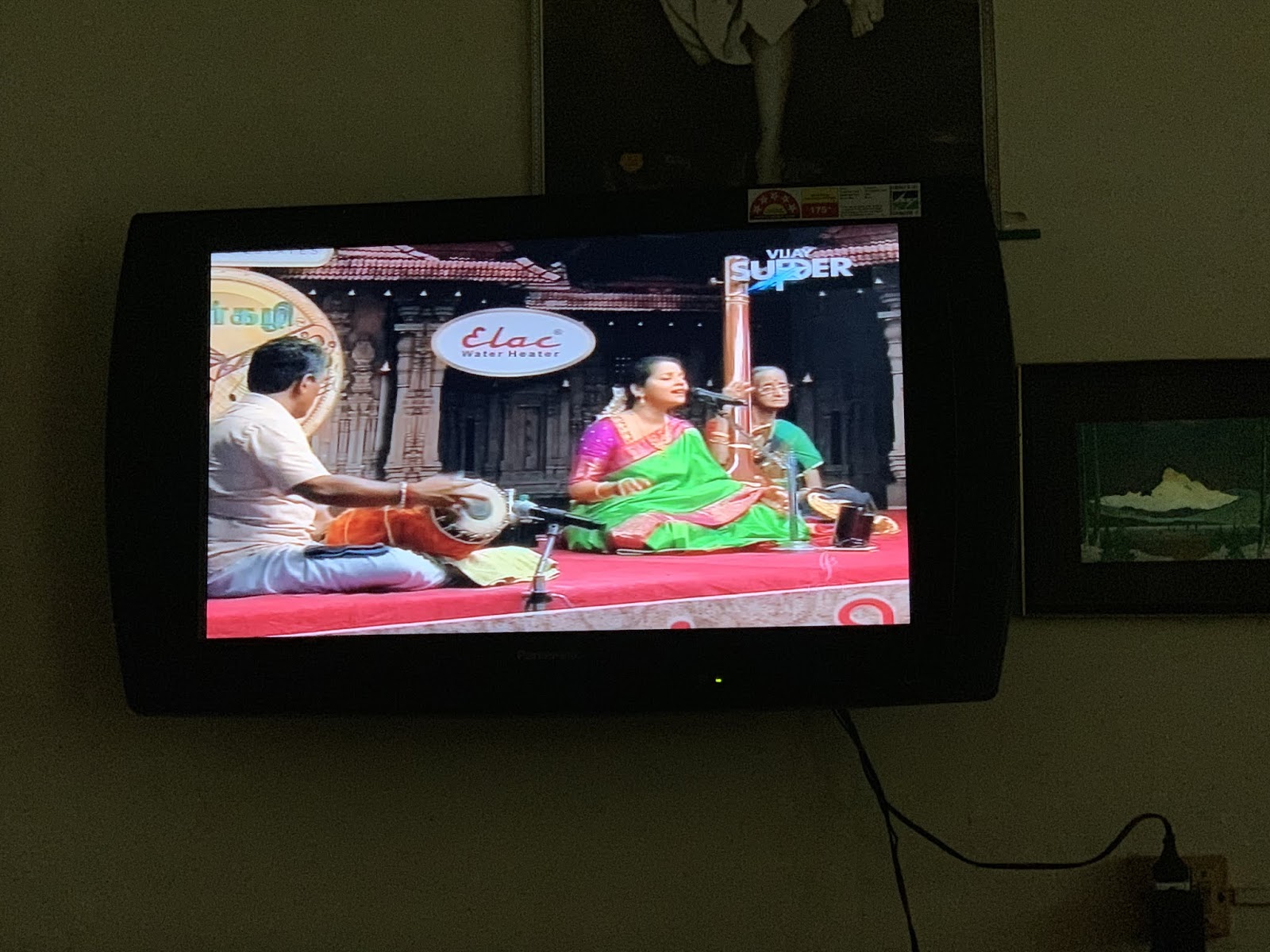
Every evening in December, Chennai lights up with concerts of talented musicians and other performing artists. The newspapers devote large sections to concert reviews and several TV stations play excerpts. All talk among the public is about who is going to which concert and who sang or performed what?! Everyone goes dressed in understated finery and has their meals at the canteens located within the concert premises, reviewing the food as they share highlights of their “music season” experiences with each other. It is a charmed life if you have a love for diverse classical art forms!
December is considered the holiest of months in the Hindu calendar. In this holy month of Marghazhi, little children having bathed and dressed in their finest, gather in hordes and walk in raucous excitement, pre-dawn, to the various temples in Besant Nagar where they sing Thiruppavai, attributed to goddess Aandal, in praise of her consort Perumal. The children and other devotees are suitably rewarded with hot pongal as Prasad (offering made to Gods then distributed to devotees), which they eat for breakfast before heading home to start their school day. Yesterday, at the Sivananda Yoga Centre there were prayers to invoke Ganesha to mark the first day of Marghazhi and we were offered tasty pongal after our yoga session.
This December, as an added bonus, I have attended weddings and bonded with family.
It is 4:30 pm, and a gentle ocean breeze has now set in. I have had a delicious cup of coffee and will dress, wear a string of jasmine flowers in my hair and set out continuing my enjoyment of Chennai in December.
Tuesday, December 4, 2018
Oh Kolkata!


Our visit to Calcutta
Over five decades into my life I still had not visited the City of Joy. So when my sister suggested a trip on my impending visit to India, I perked right up and we began planning endlessly for it. Where would we stay, what would we do etc was top of mind. As though people had read our minds, we had suggestions and offers of help from all quarters. My friends, her patients and friends. Slowly the program began to take shape. We wanted to see the real Calcutta, suspended in vestiges of it’s glorious colonial past. We also planned a visit to neighbouring Belur Math and Dakshineshwar, both of which had materialized into destinations for devotees of Swami Vivekananda and his guru, divinity incarnate, Shri Ramakrishna Paramahamsa.
I realized soon that the world is divided into two kinds of people. Those who love Calcutta and those who are shocked you would choose it as a desirable place to visit. In the past, the public sentiment towards Chennai was similar except now with so many IT back offices, its image has morphed somewhat. There is, therefore, some curiosity. None for Calcutta whose public image has been aggregated as consisting of the poor and wretched whom Mother Theresa and her Missionaries of Charity cared for, naxalites and other communist zealots thanks to 31 years of Communist party rule till 2001, pretentious intellectualism, art movies that did not condescend to appeal to populist folks, ancient trams and crumbling colonial architecture. Don’t get me wrong. Bengalis are universally still held in high esteem for their social consciousness, their celebration of goddess Durga who embodies Shakthi aka feminine power, and their love of and contributions to literature, cinema and the fine arts. Iconic figures such as Tagore and Ray are venerated world wide.
I really did not know what to expect. Our taxi, prearranged with the hotel, was there to receive us at the airport . We made it in an hour to the heart of the city. The weather was hazy, the sky overcast and grey from what appeared to be smog. First impression. It was familiar. It was polluted like most large Indian cities, choking from the effusions of the autos, ancient yellow Ambassador taxis, cars and aging public buses. Second impression. There were lots of high rises all generally shabby and old-looking with laundry hanging to dry in most balconies. Then there were over bridges under which the homeless had pitched up residences using cardboard and fabric. There was absolutely nothing shiny or new as though the city had given up on looking after itself! Third impression. Like in Chennai there were large cutouts of politicians, especially their current Chief Minister. Clearly these folks are in perpetual election mode, preoccupied with retaining their power than doing their city any good.
Over the next few days we stayed in South Calcutta, in a rather crowded part, conveniently close to the shopping areas. We had an unsanitized view of life up close, blending in with the middle class crowd. Handily, our friends who had taken up temporary residence close-by, chaperoned us as needed! We had access to great South Indian food, a non negotiable requirement for my mother who was travelling with us. So it was Calcutta on a budget and it was oh so inexpensive compared to the rest of India. Autos were no more than Rs. 40 to shopping destinations and we never paid more than Rs.100 for our cab rides. Food at restaurants was a fraction of the amount you would pay at comparable locations in Chennai.
Our one grand indulgence was a privately guided city tour where we learnt more about this fascinating city given its legacy as the capital of the British empire for the Indian subcontinent till 1911. The British left their indelible mark dividing the city into white, black and grey towns, for the white, “native” and Anglo Indian populations, respectively. The parts that were white town still retain their distinctive colonial grandeur, the imposing structures, consisting of the Governor’s residence, Town Hall, High Court, Police Headquarters, Victoria Memorial, and many many more all rivalling those in London. The residences of the past form the current “downtown” aka business district. Then there is black town where the streets are narrower and the homes less impressive. However, those who thrived under British rule, serving as Accountants, English language scribes, professionals and merchants, lived in high rises with wrought iron balconies and Venetian shutters. We were sad to see those decrepit buildings, some still occupied, others abandoned but stubbornly standing, trees growing out them, as grotesque relics of a prosperous past.
Among its greats, Kolkata celebrates Tagore, and Mother Theresa. Our first stop was Thakur Bari, the home and Museum of Calcutta’s Nobel Laureate son Rabindranath Tagore. We were transported to Calcutta’s glory days and saw its history through the eyes of its proud son. This is a “must see”. We also visited Mother house to pay homage to Saint Theresa, as she is now known, another Nobel Laureate, and a controversial figure who put Calcutta’s poor and abandoned on the map. When I climbed up a flight of stairs to the spartan 10 feet by 10 feet room, with no fan, which had been her private residence for over 40 years, till her death in 1997, I was moved to tears. To me she was the goddess incarnate.
I cannot help but think, there is a divine force that defines Kolkata. After all, Goddess Kali is ubiquitous in her residents’ hearts and minds not just as the embodiment of feminine power and the triumph of good over evil, but as a way of life. And that abiding faith in Kali manifests as respect for womenfolk, keeps them unspoilt, even joyful, and gets them through precarious living conditions. And several lakhs of them live below the poverty line in hovels and dingy spaces with open sewers.
Kali notwithstanding, Kolkata has distinct Muslim, Jain, Christian and Jewish quarters and I marvelled at the harmonious co existence of all faiths, bound by their common love of the city.
If I had to put a finger on why I have come to like Calcutta, I will say it’s the simplicity of its people and their warmth. Vendors, auto and cab drivers are all polite, endlessly patient and willing to help. No one I met was aloof or condescending. People were not out to rip us off.
Kolkatans take great pride in their city and live out large eating street food, buying cheap goods from pavement shops and riding 4 to 1 in tiny share autos. Then there is lush abundance in fruits and vegetables from the fertile soil on the banks of the Southern Ganges, as also plenty of fish from where the river meets the ocean, to keep them well fed and contented on a shoe string. Even with rampant consumerism they appear to shun greed and the need to amass. Testament to their value for substance over form are the endless rows of book shops in College Town, and rampant coffee shop/street corner chatter on global issues over tea and cigarettes.
During our short stay we visited Belur Math and Dakshineshwar, And also hit a few tourist destinations. We saw the impressive buildings around Dalhousie Square that rivalled any in London, visited Jain temples, walked the length and breadth of the famous Gariahat market, ate street food, drank hot tea from little mud pots, in Lake Market area, savoured the milk sweets, ate the best South food, paid homage to Tagore and Mother Theresa, bought a book in College Town, had lunch near Park Street, posed for a picture at the iconic Indian Coffee House, visited the famous Calcutta University, bought nighties, underskirts, kurtas and cheap jewellery.from street vendors and even watched a movie. Except for the privately guided city tour, ours was Calcutta on a budget, living among real people and experiencing the city’s grittiness. The company mattered. My sister, mother, nephew and I had belly aching laughs over the silliest of things and just went with the flow. Next time, we might do different things and there will be a next time. We concluded our trip with a visit to the famous Kali temple! I was disappointed with the temple’s upkeep though overwhelmed with a prayerfulness and quietude that came over me in the inner sanctum.
Our ride back to the airport was through Newtown, a shiny new part of Calcutta resembling Singapore! That left us with a favourable image to carry back.
Sunday, February 25, 2018
It was not Sridevi’s fault! Or was it?
The gist. She had brought this upon herself! She had been desperate to look and stay young? She had had 23 cosmetic surgeries to correct her physical appearance, to look youthful and skinny. There appeared some truth to these admonishments from society’s moral guard who had found an easy target in a deceased woman who could not defend herself. However, I could not help but see that she, not unlike other celebrities, had been living a photoshopped life for social media. When I saw a “like” from designer extraordinaire Manish Malhotra, every time she or her daughters were attired in his clothes, on Instagram, I wondered about his blatant exploitation of her vulnerability, for his personal gain. And of course, he just symbolized the capitalist world out there that sells us all a bill of goods everyday! She, like all of us, was crying out for validation but on the world stage, and to an extreme degree as if her life depended on it. The self anointed psychoanalyst in me was pumping up theories that saw her as obsessed with her looks to the point of mental instability.
But that was just too easy. And did not tell the full story. I glanced down at the book that had held me in its thrall for the past hour before this news rudely broke my attention. Serendipitously, I had just been reading about a macro phenomenon that is taking root in our world, according to Yuval Noah Harari. In his ground breaking prophetic Homo Deus, in the same genre as Alvin Toffler’s Future Shock or Third Wave, he has spun ideas about our current state of being into a beautiful tapestry. He presents a compelling perspective about our collective consciousness. His premise, based on his background as a historian, there is intentionality behind the course our universe is taking, determined by those with the power to influence outcomes, the wealthiest among us.
Till the middle of the 20th Century, the human race had been preoccupied with eliminating famine, disease and war, all of which had previously decimated civilizations. That done, humans were on to their next great quest. The pursuit of immortality, bliss and divinity, at least for those who have the means. The next frontier for science and technology is to create super humans who will continually reengineer their bodies and perpetually renew them with a refresh every ten years or so to live as long as they can, maybe hundreds of years. Several key influencers shun the idea that death is inevitable. Google’s venture Calico is looking at beating death and engendering perpetual youth. While scientists are already hard at work tinkering with our DNA to not only cure disease but to preempt illness and counter the negative effects of aging, the world of merchandising is selling “the perfect look” and doctors are already superficially “fixing” bodies to embody the spirit of this aspiration, but without the science. The end result, we are all hurtling towards a future where an obsessive preoccupation with staying young will continue to vilify the aging process and create a society of second class citizens among those who cannot afford to stay “young” at all costs. And it will be expensive and only available to a chosen few!
It’s not all bad news. There is also a rising consciousness that allows us to uncover the root of all our suffering (aka discontent with our lot) and to see it as being our attachment to everything that is passing. So we need to hang on to that raft and stay present or be swept away into this maelstrom!
Disclaimer- the above is based on assumptions about what happened. I don’t have the facts!
Subscribe to:
Posts (Atom)